
Hurricane Tree Prep for Wilmington Yards
The most useful way to get Wilmington yard trees ready for hurricane season is to have the large trees within reach of your house looked at before summer storms arrive, remove dead, cracked or hanging limbs, deal with storm-prone trees leaning over the roof, and avoid heavy pruning or topping that leaves trees weaker. Then plan ahead for power lines and debris. June through September brings about half of Wilmington's yearly rain, and soaked, sandy ground with a high water table is where trees tip over in the wind.
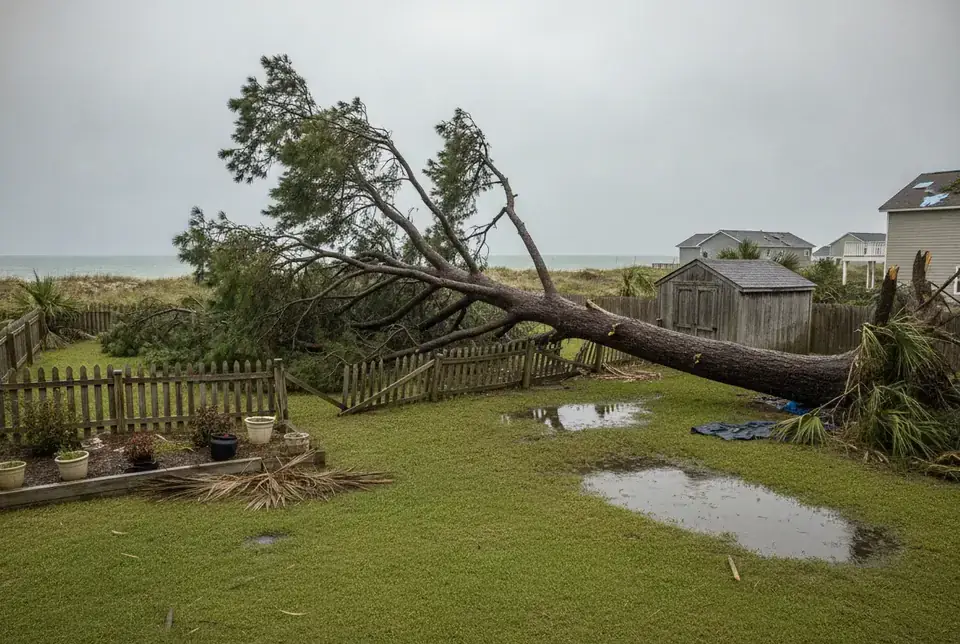
Why Wilmington trees come down in storms
Wind is only part of it. According to NOAA's 1991–2020 normals for Wilmington International Airport, the city gets about 60.15 inches of rain a year, and June through September supplies roughly 49% of it. September is the wettest month (8.69 inches), followed by August (8.16) and July (6.86). So the peak of hurricane season arrives when the ground is already wet.
The soil adds to the problem. NRCS soil descriptions for coastal series such as Baymeade, Kureb, Leon and Murville range from very shallow to deep water tables. NC State Extension in Pender County advises against large trees where the water table is within 18 inches of the surface: roots stay shallow, and windthrow risk goes up.
The local record shows what that adds up to. The National Weather Service reports that Hurricane Florence, which made landfall at Wrightsville Beach on September 14, 2018, dropped 23.02 inches of rain on the airport with a 105 mph gust. More than 90% of New Hanover County lost power, restoration took more than 10 days, and crews collected over 1.2 million cubic yards of debris. Matthew (2016) gusted to 70 mph at the airport and 77 mph at Wrightsville Beach, with damage mainly to trees and power lines (NWS). Isaias (2020) hit 73 mph at the airport and 85 mph at Wrightsville Beach and left about 85,000 New Hanover residents without power (NWS). Winter matters too: the February 11–12, 2014 ice storm put 0.56 inches of ice on the airport (NWS).
Step 1: Know which trees to look at first
NC State Extension, citing hurricane studies, lists pines, laurel and water oaks, Bradford pear, Leyland cypress, red and silver maple, tulip poplar and pecan among the trees to keep away from houses. That list covers much of Wilmington. Laurel oak alone is about 14% of the city's public trees, and a UF/ISA hurricane study found laurel oak survived significantly worse than live oak.
Walk your yard and note every large tree that could reach the house, garage, driveway or a neighbor's roof if it fell. Those are the ones to have assessed. If you have water or laurel oaks, our post on water oak and laurel oak storm risk goes deeper. If you have pines that look off-color, check the signs of southern pine beetle.
Step 2: Look for the obvious warning signs
- Dead branches, or limbs that are broken and hanging in the canopy.
- Cracks or splits in the trunk or where large limbs join it.
- A lean that is new or getting worse.
- Large limbs reaching over the roof, especially from storm-prone species.
- Pines with needles turning yellow or orange.
If you see any of these on a tree that can reach your home, an arborist assessment is a sensible next step. Published cost guides put a tree inspection at about $198 on average in Wilmington, and cabling or bracing at about $382, as estimates, not quotes. See the full price guide for removal and trimming ranges.
Step 3: Prune moderately, and never top
Thinning dead wood and reducing a few heavy limbs is reasonable storm prep. Topping is not. The International Society of Arboriculture says topping removes 50–100% of the leaf-bearing crown and "will make a tree more hazardous in the long term," because the sprouts that regrow are weakly attached (ISA, Why Topping Hurts Trees). NC State Extension also notes that severe pruning increases decay and failure risk. When you compare tree trimming quotes, ask each company exactly what it plans to cut and why.
Step 4: Book early
Searches for tree service in Wilmington peak in September and October, which is also when companies are busiest. Getting quotes in late winter or spring gives you time to compare and check credentials. Before you hire, ask the company for:
- A certificate of general liability insurance and workers' compensation coverage.
- Whether an ISA Certified Arborist is on staff (a private credential from the International Society of Arboriculture, not a state license; verify at treesaregood.org).
- Whether the company is TCIA Accredited (a private Tree Care Industry Association program).
- An NC commercial pesticide applicator license (Ornamental & Turf category) if they will spray or inject.
- A written quote that states cleanup, haul-away, stump grinding depth and whether a permit is included.
Step 5: Check permits before anything comes down
Storm prep does not suspend local rules. In the City of Wilmington, trees in the right-of-way, on residential lots over one acre, in buffers or in historic districts need a permit, and in Wrightsville Beach even trimming a live oak needs a Tree Alteration Permit. Our post on Wilmington tree removal permits has the details. This is general information, not legal advice.
Step 6: Plan around power lines
If a tree is touching or near a power line, stay away and call your electric utility (Duke Energy, or your co-op) — only utility-qualified crews should work near energized lines. Don't hire anyone to work on limbs tangled in the line to your house, and don't try it yourself.
Step 7: Plan for debris after the storm
Under the City of Wilmington yard waste rules, curbside limbs can be no more than 4 feet long and 6 inches in diameter, up to 7 cubic yards per collection. The city does not pick up palm trunks, stumps or root balls, or debris created by commercial contractors. So if you hire a company to cut up a fallen tree, make sure your quote includes haul-away. The city's page only asks for patience when storms create large volumes of debris. Unincorporated New Hanover and Pender counties have no routine curbside yard pickup.
If a tree does come down, some companies offer after-hours or storm response; availability depends on the company and the storm. Our emergency and storm tree removal page covers what to do first.
Step 8: Plant for the next storm
When you replace a lost tree, pick a species that holds up. The same hurricane studies rank live oak, southern magnolia and bald cypress as the most wind-resistant large trees, and sabal palm, yaupon, American holly, dogwood and crape myrtle among the toughest small ones. Our guide to wind-resistant trees for coastal NC covers placement and spacing.
Want a professional opinion before the season starts? Request free quotes from independent local tree companies. The company you choose quotes, contracts and does the work directly with you. Call (727) 300-6656