
Which trees hold up to hurricane wind on the North Carolina coast? NC State Extension's Pender County Center, drawing on studies of trees that came through Florida and Gulf Coast hurricanes, names live oak, southern magnolia and bald cypress as the most wind-resistant large trees, and dogwood, American holly, yaupon, crape myrtle and sabal palm as the toughest smaller ones (Planting Trees With Hurricanes in Mind). The same article lists pines, laurel and water oaks, Bradford pear, Leyland cypress, red and silver maple, tulip poplar and pecan among the trees to avoid near structures.
Wilmington NC Tree Removal is a free quote service. We connect Wilmington-area homeowners with independent local tree companies for free, no-obligation quotes. The company you choose quotes, contracts and does the work directly with you.
For storm-season checklists, see our separate hurricane tree prep guide.
Why wind resistance matters so much in Wilmington
The Cape Fear coast gets tested regularly. When Hurricane Florence made landfall at Wrightsville Beach on September 14, 2018, the National Weather Service recorded 23.02 inches of rain and a 105 mph gust at Wilmington International Airport. Over 90% of New Hanover County lost power, restoration took more than 10 days, and crews collected over 1.2 million cubic yards of debris (NWS Wilmington, Florence). Hurricane Isaias in 2020 brought a 73 mph gust at the airport and 85 mph at Wrightsville Beach, and left about 85,000 New Hanover residents without power (NWS, Isaias).
Timing makes it worse. NOAA's 1991–2020 normals for the airport put the wettest months at September (8.69 in.), August (8.16) and July (6.86); June through September brings roughly 49% of the year's 60.15 inches (NOAA climate normals). The wettest stretch overlaps peak hurricane season, so storms often arrive when sandy soil is already soaked, and wet soil plus wind is a common recipe for uprooted trees.
The city's canopy has taken the hit. Wilmington's tree canopy was 41.4% citywide in 2020, after the city lost 16% of its canopy over the prior four years, mainly from natural disasters and development (Port City Daily, 2023).
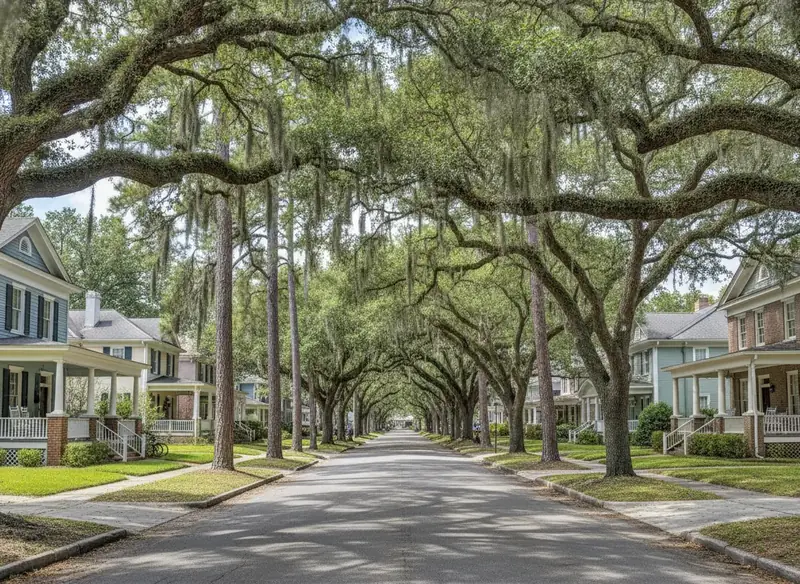
The most wind-resistant large trees
A University of Florida study published by the International Society of Arboriculture (Duryea and colleagues) tracked how trees survived a series of hurricanes. Sand live oak, American holly, southern magnolia, live oak, wax myrtle, sweetgum, crape myrtle, dogwood and sabal palm ranked highest for survival (Arboriculture & Urban Forestry 33(2)). Pender Extension's short list of large trees lines up with it:
- Live oak. A familiar Wilmington street tree and about 8% of the city's public trees (Port City Daily). Large live oaks can be protected trees, so check the rules before you prune or remove one; our Wilmington tree permit guide explains where to ask.
- Southern magnolia. Ranked highly for survival in the UF/ISA study and named by Pender Extension as a wind-resistant large tree.
- Bald cypress. Named by Pender Extension among the most wind-resistant large trees. WHQR lists it, with live oak and pond cypress, among the old native trees Wilmington's rules treat as specimen trees (WHQR).
Smaller trees that handle wind well
If you want something under the power lines or close to the house, the smaller trees in the research are dogwood, American holly, yaupon, crape myrtle and sabal palm. Wax myrtle also ranked highly in the UF/ISA survival study.
Sabal palm (cabbage palm) is worth a special mention: both Pender Extension and the UF/ISA study place it among the most wind-resistant trees on the coast. It still needs frond care, and the City of Wilmington's yard waste program will not pick up palm trunks (City yard waste rules), so ask any palm trimming quote to include haul-away. Crape myrtle holds up well too, as long as it isn't topped; see crape myrtle pruning without crape murder.
Trees to keep away from the house
Pender Extension's avoid-near-structures list also includes lacebark elm and green ash. Two entries matter most in Wilmington:
- Laurel oak. About 14% of the city's public trees, one of the most common species in town. In the UF/ISA study, laurel oak survived significantly worse than live oak. Our post on water oak and laurel oak storm risk goes deeper.
- Pines. Tall loblolly pines are everywhere in newer neighborhoods. They are on the storm-prone list, and they are also the host for southern pine beetle.
None of this means a laurel oak or pine has to come down. It means it deserves a closer look than a live oak would, especially if it leans toward a roof, driveway or bedroom.
Soil and water table matter as much as species
A wind-firm species planted in the wrong spot can still go over. The coastal soils around Wilmington vary a lot. USDA-NRCS descriptions show Kureb sand with a water table deeper than 6 feet (Kureb) and Baymeade with a water table about 45–60 inches down in winter and spring (Baymeade). At the other extreme, Leon soils have a water table at 6–18 inches for one to four months in most years (Leon), and Murville soils sit at 0–1 foot from November to May (Murville).
Pender Extension advises against planting large trees where the water table or a compacted layer is within 18 inches of the surface. Roots stay shallow there, and shallow roots mean more risk of the whole tree tipping over (windthrow). If your yard stays soggy for weeks after rain, put smaller wind-firm species there and save the live oak for higher, better-drained ground.
How to plant for wind
- Plant in groups. Pender Extension recommends planting in groups of five or more within 10 feet of each other.
- Skip severe pruning. The same article notes that severe pruning increases decay and failure risk.
- Call 811 before you dig. NC811 asks for a locate request for every digging project, planting a tree included (NC811). Our 811 guide covers how that works.
What to do with storm-prone trees you already have
Start with a look from someone who knows trees. An arborist assessment can tell you whether a laurel oak or pine has decay, a bad lean or weak limbs, and whether cabling, pruning or removal makes sense. Published cost guides put an arborist assessment or tree inspection at about $198 on average in Wilmington, cabling or bracing at about $382, and tree removal at about $695 on average (LawnStarter Wilmington) — typical ranges from published cost guides (2025–2026) — estimates, not quotes. See the full tree removal cost guide for ranges by height.
Before removing a large tree, check whether a permit applies and whether your HOA requires architectural approval — many do, so check your covenants. This is general information, not legal advice.
If a tree is touching or near a power line, stay away and call your electric utility (Duke Energy, or your co-op) — only utility-qualified crews should work near energized lines.
Frequently asked questions
What is the most wind-resistant tree for the NC coast?
Among large trees, NC State Extension's Pender County Center names live oak, southern magnolia and bald cypress as the most wind-resistant, based on studies of trees after Florida and Gulf Coast hurricanes. For smaller spaces, dogwood, American holly, yaupon, crape myrtle and sabal palm held up well. Site matters too: avoid large trees where the water table sits within 18 inches of the surface.
Are pine trees near my house a storm risk?
NC State Extension lists pines among the trees to avoid near structures in hurricane country. That does not mean every pine must come down. A tree that is healthy, well rooted and not leaning toward the house may be fine. An arborist assessment can check for decay, lean, root problems and signs of pine beetle before storm season.
Should I replace laurel oaks with live oaks?
Laurel oak survived hurricanes significantly worse than live oak in a University of Florida study published by the International Society of Arboriculture. If a laurel oak is declining or hangs over your home, replacing it with a live oak or another wind-firm species on suitable, well-drained ground is a reasonable long-term plan. Check permit and HOA rules before removing it.
Get a free quote for storm-prone trees
If a pine or laurel oak is worrying you before the next storm, a free, no-obligation quote request takes about a minute. We usually reply the same day and connect you with independent local companies; you decide whether to move forward.